
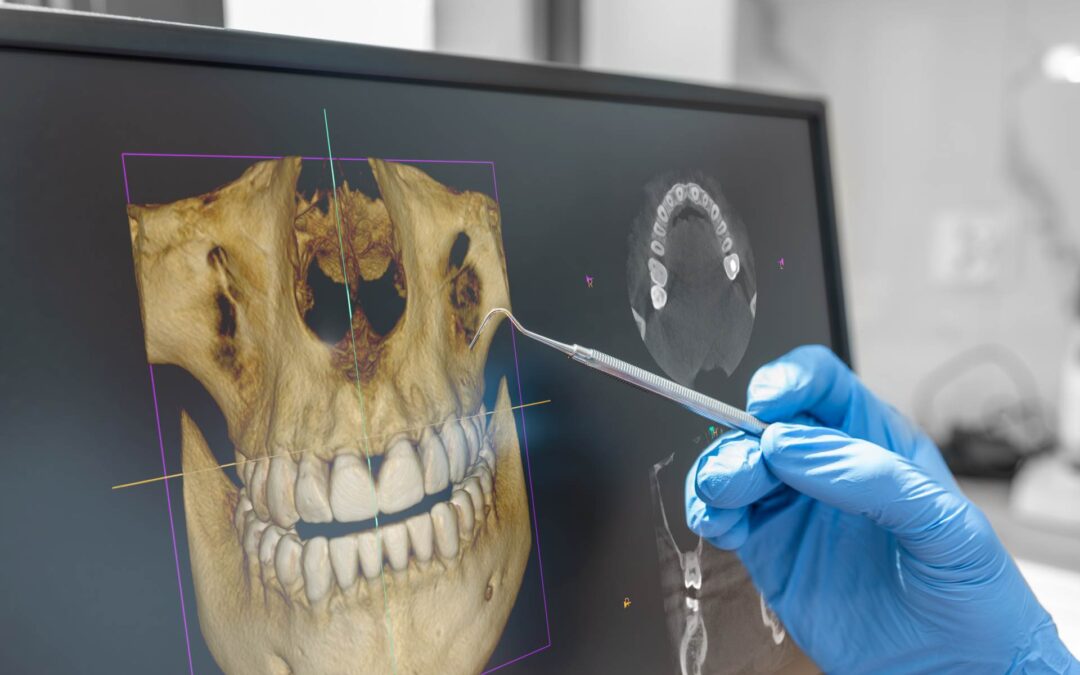
Dental care has changed dramatically over the years, largely due to advances in diagnostic technology. One of the most important tools in modern dentistry is dental CT imaging. This technology allows dentists to view teeth, bone, nerves, and surrounding structures in three dimensions, offering a level of detail that traditional X-rays simply cannot provide. At BENE Dental in Norwell, CT imaging plays a key role in accurate diagnosis, careful planning, and safer treatment—especially for implants, extractions, and complex cases.
What Is Dental CT Imaging?
Dental CT imaging, also known as cone beam computed tomography, captures a three-dimensional image of the mouth using a single, quick scan. Instead of a flat picture, the scan shows depth, angles, and spatial relationships between structures. This allows dentists to see bone thickness, nerve pathways, sinus positioning, and tooth roots with exceptional clarity.
Because the image is digital, it can be rotated, magnified, and examined from multiple angles. This gives dentists the information they need to plan treatment precisely rather than relying on estimates.
How CT Imaging Differs From Traditional Dental X-Rays
Traditional dental X-rays are still useful for routine care, but they provide only two-dimensional images. While they can reveal cavities or obvious infections, they do not show how deep a problem goes or how structures relate to one another.
Dental CT imaging provides a much more complete picture. It allows dentists to evaluate bone volume, detect hidden infections, identify root fractures, and locate nerves before treatment begins. This reduces uncertainty and allows procedures to be planned with confidence rather than guesswork.
Why 3D Dental Scans Improve Treatment Accuracy
Precision matters in dentistry, especially when working near sensitive structures like nerves and sinuses. A 3D dental scan allows dentists to plan treatment digitally before performing it clinically. This planning helps reduce complications and improves overall outcomes.
For patients, this often means shorter procedures, fewer surprises, and smoother healing. When dentists can see exactly where an implant should go or how a tooth is positioned, treatment becomes safer and more predictable.
CT Imaging for Dental Implant Planning
Dental implants require a strong foundation, and CT imaging is essential for evaluating whether that foundation exists. The scan allows dentists to measure bone height and width, assess bone density, and determine whether additional procedures like bone grafting are needed.
CT imaging also helps dentists place implants at the ideal angle and depth while avoiding nerves and sinus cavities. For implant planning in Norwell, this technology plays a major role in long-term implant success and patient comfort.
CT Imaging for Tooth Extractions and Oral Surgery
Some tooth extractions are more complex than others, particularly impacted wisdom teeth or teeth with curved roots. CT imaging shows the exact position of these teeth in relation to surrounding bone and nerves.
This allows dentists to plan a surgical approach that minimizes trauma and reduces the risk of complications. Patients often experience less swelling, less discomfort, and faster recovery when extractions are guided by detailed imaging.
Detecting Hidden Dental Problems
Not all dental problems are visible during a routine exam. Cracks below the gumline, deep infections, cysts, or bone defects may remain hidden without advanced imaging.
Dental CT imaging allows dentists to detect these issues early, before they cause significant pain or damage. Early diagnosis often means simpler treatment and better long-term outcomes.
Evaluating Bone Loss and Gum Disease
Advanced gum disease affects both the gums and the underlying bone. CT imaging provides a clear view of bone loss patterns, helping dentists determine the severity of periodontal disease and plan appropriate care.
This level of detail helps protect remaining bone and supports more effective treatment strategies aimed at preserving natural teeth whenever possible.
Safety of Dental CT Imaging
Patients often ask about radiation exposure. Dental CT imaging uses significantly lower radiation levels than medical CT scans and is considered safe when used appropriately. At BENE Dental, CT scans are recommended only when they provide clear diagnostic value.
Modern equipment and careful protocols ensure that exposure is kept as low as possible while still delivering the information needed for safe care.
What to Expect During a CT Scan
A dental CT scan is quick, comfortable, and non-invasive. Patients simply remain still while the scanner rotates around the head for several seconds. There is no pain, no recovery time, and results are available immediately for review.
How CT Imaging Improves Patient Understanding
One of the most valuable benefits of CT imaging is communication. Dentists can show patients exactly what is happening in their mouth using clear visual images. Seeing bone loss, infection, or implant positioning helps patients understand why treatment is recommended and feel more confident in their decisions.
Why BENE Dental Uses Advanced Imaging
At BENE Dental in Norwell, we believe better information leads to better care. CT imaging allows us to diagnose accurately, plan precisely, and treat safely. It supports implant success, surgical safety, and long-term oral health.
Clear Imaging Leads to Better Results
Dental CT imaging is not just advanced technology—it’s a tool that directly improves patient outcomes. By seeing the full picture, dentists can deliver care that is more accurate, comfortable, and predictable.
If you are considering implants, extractions, or complex dental treatment, schedule a consultation with BENE Dental in Norwell. With advanced 3D imaging, your care starts with clarity and confidence.